
|
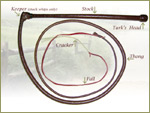
Caring for your Whip
Your whip doesn't require a great deal more
than basic common sense procedures to help it last a lifetime.
|
Try not to leave it exposed
to the elements day in day out without protecting it.
A good hide food rubbed in every few months
is all that is needed. These usually contain a lanolin waxy cream
or a beeswax base. Apply evenly and sparingly with a soft cloth
changing cloth surface frequently. Leave to dry and polish with
a soft dry cloth. A good clean with saddle soap from time to time
will also be of benefit. Mutton fat is also very good. |
DO NOT USE ANY OIL BASED
PRODUCT, INCLUDING NEATS FOOT OR MINK OIL.
When your whip first arrives,
give it a polish with a soft cloth. Similarly keep your whip dry and
do not strike hard objects with it. Make sure you avoid striking the
ground and it is probably best not to practice on concrete unless you
are skilled.
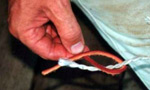 |
Learn to Attach a Cracker
Replacing a worn or dislodged cracker is
a simple task that can be easily performed by any whip handler.
Click here to view the process.
An enlarged cracker for a photographic step by step demonstration
has been used. |
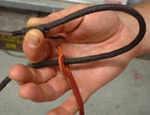 |
Learn to Attach a Fall
Replacing a worn or dislodged fall requires
more skill and patience than replacing a cracker but can be achieved
by the average handyman with the right tools.
Click here to view the process.
The photographs in my demonstration are self-explanatory
with respect to the methodology. |
 |
Learn to crack a whip
If you want to learn how to crack a whip,
take a look at the website Point
Man Productions. Here you will find the Anthony De Longis
videos, which are recommended for learning to crack a whip by
a number of my clients.
Alternatively you can call them on +1 310 530 6753. They are in
California, USA. |
|